
Apple Valley Resident Lookup Records
San Bernardino County splits a one-person search among several custodians. The Assessor can connect a parcel to an assessee and mailing address. The Recorder index can show a party's role in a recorded document. Superior Court can show a case party and docket events. Vital records answer family facts under authorized-copy rules. Business and license systems add public affiliation or credential context. Each layer has a different access rule, so a name match in one source should not be presented as proof of current residence.
| Record | What It Confirms | Where | Access |
|---|---|---|---|
| Assessor parcel | APN, situs, assessee, and mailing distinction | San Bernardino County Parcel Access | Free map and downloadable rolls; no special owner-name query |
| Recorded documents | Grantor, grantee, document type, date, and number | ARC Official Records Index | Free index; image at a counter or by copy order |
| Court cases | Party role, case type, status, events, and disposition when entered | Superior Court CAP | Remote index is limited; clerk access may show more |
| Probate files | Decedent, representative, heirs, and beneficiaries in public filings | Victorville or Fontana probate through CAP | Notes and confidential material have access limits |
| Vital records | Birth, death, public marriage, or dissolution facts | County Recorder-Clerk and CDPH-VR | Application, eligibility, and 2026 fees vary by record |
| Voter status | A person's own registration and election details | California My Voter Status | Identity-gated self-lookup, not a name directory |
| Business or license | Entity, agent, public filing, credential, or status clues | California bizfile and DCA search | Free public search; verify with the responsible custodian |
| Town administrative record | Existing permit, planning, code, or correspondence record | Town Clerk, Government Services, or CPRA route | Focused request; no new person dossier is required |
Start with the clue that is already known. An address points to Parcel Access. A case number points to CAP. A family event points to the Recorder-Clerk or CDPH application. A trade name points to bizfile or a fictitious business-name filing. When the only clue is a common name, use a small set of independent anchors before asking any custodian for a copy. That is the core of a careful Apple Valley resident lookup.
Recorder images are not displayed through the free online index. Use the Hall of Records in San Bernardino, the High Desert Government Center in Hesperia, or a copy-order route. The index begins in 1925, and the document number, date, title, grantors, and grantees should be recorded before an in-person or mail request.
Apple Valley Resident Lookup Probate Notes for an Heir
Probate is a practical one-person search route when the real question is an heir, personal representative, or family connection. San Bernardino Superior Court probate matters are shared by the Victorville and Fontana locations. The Court Access Portal can expose a public case index and docket material, but a petition, inventory, or notice may require the district clerk or a document request. Probate is not held by the Assessor-Recorder-Clerk, and the court's administrative-records request page is not the route for a probate case file.
The Superior Court probate page describes the Victorville and Fontana probate path for the High Desert region.
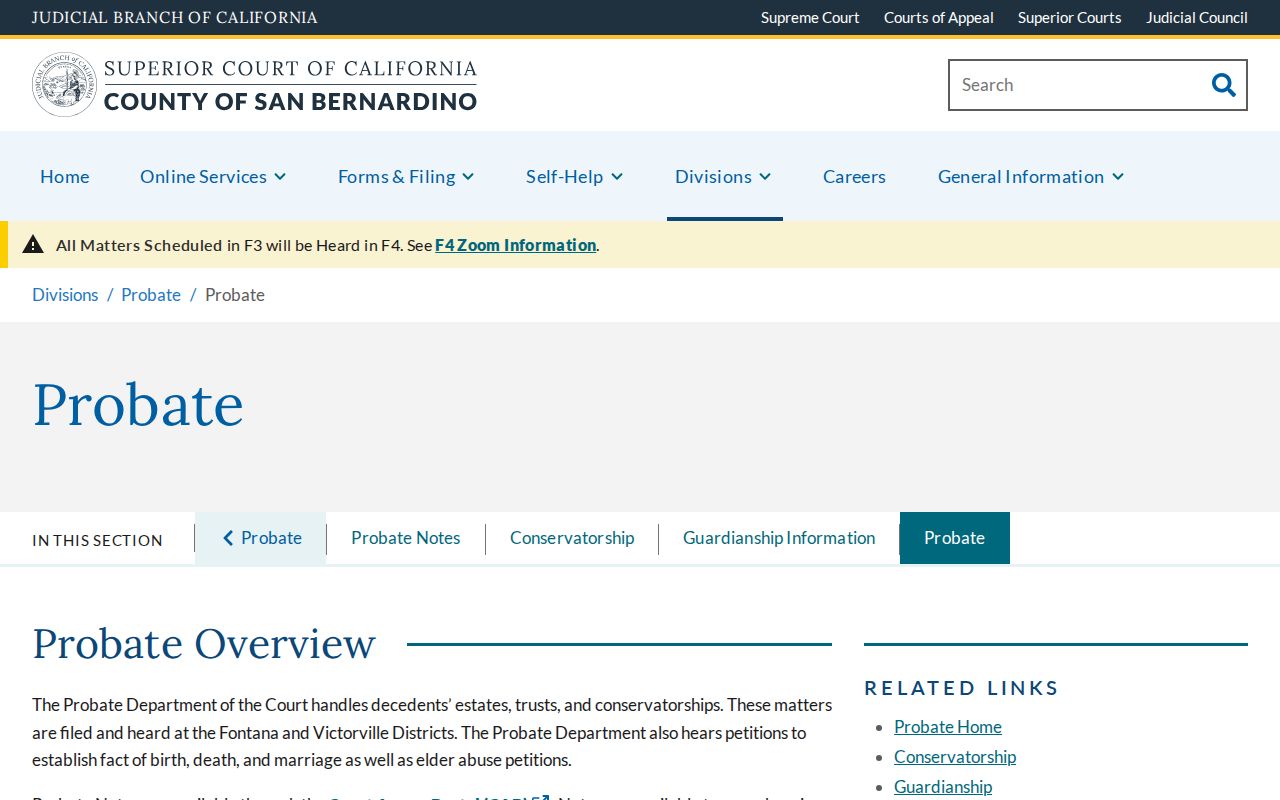
The probate page image shows the court's division-level access route. Save the case number, filing date, and document title before calling the clerk; those details make a request narrower and reduce the risk of merging two families with similar names.
Probate Notes are unusually time-sensitive. The research record says they appear in CAP about two weeks before a hearing and remain for seven days afterward. Save the note during that window if it is public. A probate petition can name heirs, beneficiaries, a personal representative, and addresses, while a confidential investigator report or financial detail may stay restricted. An heir trail is strongest when a probate name is compared with an obituary, a recorded deed, and a family relationship stated in a public filing.
Apple Valley Resident Lookup CAP Fields
The Superior Court Court Access Portal begins with “Access Court Case Information” and then Case Search. A party search is more useful when a surname is paired with a first name, case type, filing window, or date of birth where the portal lawfully displays that field. The official CAP case-search instructions are the controlling reference for the live form because labels and dynamic options can change.
| Case number | Fastest exact key when known; use the court's format. |
|---|---|
| Party or defendant last name | Primary name field; try spelling variants and former names. |
| First name | Narrows a common surname when the portal accepts it. |
| Date of birth | Identity discriminator in the case types and displays where lawfully available. |
| Case type | May include civil, criminal, family, probate, small claims, traffic, and related groupings. |
| Filing date range | Reduces a long result set when an approximate year is known. |
Sample CAP result inventory. A public result can include case number, case title, filing date, courthouse or district, case category, party names and roles, status, hearings, departments, register-of-actions entries, and a disposition when entered. A document icon does not guarantee that the document can be viewed remotely. Family, juvenile, adoption, mental-health, sealed, and confidential material is restricted in different ways.
A name match is not identity proof. Compare the party role, case geography, event dates, a middle name or lawful age detail, and any accessible address. A resident lookup should cite the case number and the exact field that separates this party from a same-name result. When the result matters, call or visit the Victorville clerk with the case number and request a specific document or certified copy. Older files may require archive retrieval. Once the question shifts from one person to everyone along a road, use the Apple Valley street directory workflow instead.
Confirm an Apple Valley Resident
A careful name check separates discovery from verification. The first source creates a lead. The second source must be independent enough to test the lead, not simply repeat the same copied data. An APN and legal description are stronger property anchors than a mailing address alone. A case number, filing date, spouse, business entity number, or lawful age match can separate two people with the same name.
- Write the name exactly as known, including initials, former names, compound surnames, and diacritics. Add the approximate place and time.
- Use Parcel Access only when ownership is plausible. Record APN, situs, assessee, mailing address, and the date of the displayed information.
- Search the Recorder index by party name and spelling variation. Interpret grantor and grantee roles with the document type.
- Run CAP with the name, case type, date range, and other lawful discriminator. Save case number and party role.
- Confirm the specific fact with a vital, probate, newspaper, business, license, or other custodian source, then label uncertainty.
- Docket
- The court's running case record, including filings, events, hearings, and status entries.
- Index versus image
- An index is a catalog of fields; an image is the underlying scanned or filed document. A free index does not mean the image is free or remotely open.
- Certified copy
- A copy issued or certified by the record custodian for a purpose that requires official attestation, subject to eligibility and fee rules.
- Party role
- The person's legal position in a record, such as grantor, grantee, petitioner, respondent, heir, or agent. It is not a conclusion about conduct.
Apple Valley Resident Lookup Vital Records and Eligibility
Vital records can verify a family event, but California does not use one blanket waiting period for all births, deaths, and marriages. A resident lookup should use a vital record only for the specific family fact it can lawfully confirm. The County Recorder-Clerk can issue county copies, while the California Department of Public Health-Vital Records serves statewide applications. Birth and death informational copies are generally available to any requester but are marked informational and cannot establish identity. Authorized copies require a permitted relationship under Health and Safety Code sections 103526 and 103526.5 and a sworn statement. Public marriage copies are broadly obtainable; confidential marriage copies require a party or court order under Family Code section 511.
| Record | General route | Access boundary | 2026 state fee |
|---|---|---|---|
| Birth | County Recorder or CDPH-VR application | Informational copy generally open; authorized copy has statutory classes and sworn statement | $31 |
| Death | County Recorder or CDPH-VR application | Informational copy generally open; authorized access is narrower | $26 |
| Public marriage | County Recorder or CDPH-VR | Public certified copy generally obtainable with identifying facts | $19 |
| Confidential marriage | County of issuance | Party to the marriage or court order | County fee; verify current schedule |
| Dissolution certificate | CDPH-VR for years it maintains | Certificate is not the full court decree | $18 |
| Divorce decree or case file | San Bernardino Superior Court | Public portions follow court access rules | Court copy fee |
The California vital-records application page requests the record type, number of copies, names, event date and place, parents' or spouses' names, requester relationship, purpose, mailing details, signature, and payment. The 2026 CDPH fee schedule lists the current state amounts. A mailed authorized birth or death request normally needs a notarized sworn statement. The search fee is retained if no record is found. Adoption records and original birth certificates are sealed under Health and Safety Code section 102705, so a public name search cannot substitute for the official adoption-information route.
Apple Valley Voter Status Limits
California My Voter Status is an identity-gated self-service tool. It is meant for a voter to check their own registration details, not for a stranger to browse Apple Valley names by street, ZIP, or household. The registration gateway also warns Safe at Home participants not to use ordinary online registration and directs them to the confidential process. The My Voter Status screen asks for first name, last name, date of birth, and a conditional California driver license, identification-card, or Social Security digit match, with county selection when required.
A matched self-record can show status, residence and mailing information to the voter, party preference, precinct and districts, polling or vote-by-mail status, and election history. Participation history says whether a person voted; it does not show ballot choices. A nonmatch can reflect spelling, recent updates, cancellation, protected status, or wrong identity data.
Election Code section 2194 restricts underlying voter information to election, scholarly, journalistic, political, or governmental purposes. A qualified requestor must apply through the Secretary of State or county elections official, identify the requestor, describe the permitted use, and follow release limits. The San Bernardino County Registrar of Voters is the local contact for current application delivery and geographic or field questions. No public Apple Valley street-voter fee was located in the documented material.
Apple Valley Adoption Records Route
Adoption is a human-use case where a name search can cause harm or simply reach a dead end. California adoption records and original birth certificates are sealed under Health and Safety Code section 102705. An adoptee or eligible birth relative should use California Department of Social Services adoption-information procedures and the Mutual Consent Program, not a public directory, a probate guess, or a purchased data file.
The lawful route depends on the person's relationship, age, consent, and the record sought. A public birth index may offer a lead, but it cannot unseal an original record. Use the issuing custodian for a certified copy, and keep an informational copy distinct from identity proof. A family-history question can also be approached through an obituary, yearbook, or newspaper, but those sources should not be used to expose a protected person or bypass a consent process.
Human use. An heir or birth-family trail is strongest when official eligibility, probate or vital procedure, and a dated secondary clue are kept in separate steps. A missing public result may reflect lawful confidentiality rather than a missing person.
Apple Valley Resident Records: Business and Licenses
Business and professional records can help distinguish two people, but they are affiliation clues rather than resident proof. California Secretary of State bizfile accepts keyword, exact, begins-with, and entity-number searches. Matching is case-insensitive, punctuation is normalized, and keywords over 12 characters are truncated for matching. Corporation numbers use a C plus seven digits; LLC and LP numbers use 12 digits. Results can show entity number, name, registration date, jurisdiction, status, addresses, agent for service, filing history, and free imaged statements.
The California business search warns that ownership, phone, email, subsidiaries, and related businesses are generally not made of record. A fictitious business-name filing with the Recorder-Clerk can connect a trade name to a registrant, but it does not prove that the registrant lives at the business address. The State Controller's unclaimed-property search can show a former city association, not a current home.
The Department of Consumer Affairs license search accepts board or license type, name, license number, and city or county. It may display status, issue or expiration dates, and discipline. Check the responsible board for the primary record. Treat an agent, licensee, contractor, or filing signer as the role shown, not as a complete biography.
Apple Valley CPRA Requests for Existing Records
When a portal stops short, a focused California Public Records Act request can ask the Town or county for an identifiable existing record. California's CPRA is Government Code section 7920.000 and following. A requester ordinarily does not need to state a purpose. The agency usually determines within 10 days whether responsive records are disclosable, with a written 14-day extension in unusual circumstances. Inspection is free; copies generally cost direct duplication, and exemptions must be tied to a legal basis.
Describe the department, date range, address, APN, permit, planning case, code case, agenda item, or correspondence record. Ask for electronic delivery when available. The Town Clerk or Government Services route can direct a municipal request. CPRA cannot force an agency to create a new resident list, and it cannot override confidential voter, vital, adoption, medical, or safety information.
The Superior Court administrative-records request page distinguishes judicial administrative records from case files and excludes divorce, case, traffic, probate, name-change, and jury records from that route.
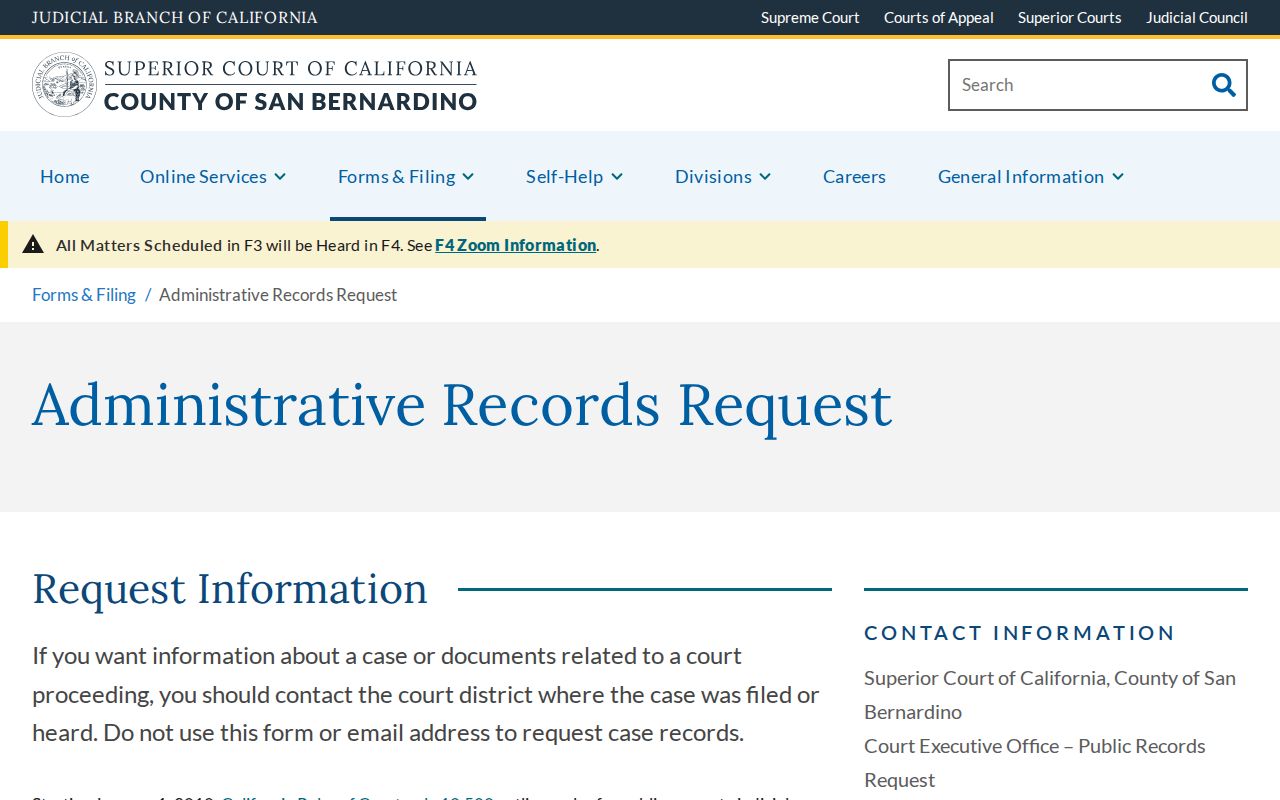
The administrative-records image reinforces the routing boundary: a case-file question belongs with the district clerk or CAP, while an administrative question follows the court's separate procedure.
Note: A CPRA request can seek a record that exists; it does not turn a custodian into a search service for every person associated with an address.
Safe at Home: Apple Valley Resident Privacy
Safe at Home gives qualifying survivors and people who fear for their safety a substitute mailing address, confidential voter registration, a confidential name-change path, and possible DMV suppression. Government Code sections 6205 through 6211 govern the program, and section 6209.5 permits qualifying participants to replace a residence address in specified real-property instruments. It does not erase information that was already made public, and vital certificates have statutory exceptions.
A protected address may therefore be absent from a property, voter, or person-search result by design. Do not treat the absence as proof that the person moved, died, or never lived in Apple Valley. A resident lookup can end at a lawful confidentiality rule rather than an empty record. California privacy rights also include access, correction, deletion subject to exceptions, limits on sensitive information, and opt-out rights under Civil Code section 1798.100 and following. Send only the minimum verification needed to a data custodian, and do not transmit identity documents through an insecure channel.
Insider tip. When a search ends at a confidentiality rule, preserve the question and source date, then ask the custodian what lawful record or appeal route remains. A protected resident should not have to defeat a safety program to be “verified.”
Apple Valley PACER Resident Lookup
Federal cases are separate from San Bernardino Superior Court. The U.S. District Court for the Central District of California uses PACER for federal civil and criminal filings, and the Central District Bankruptcy Court uses PACER or VCIS for bankruptcy cases. Search by party or case number, then read the court, filing date, case type, chapter, status, and document docket. A federal hit can clarify a party role or filing event, but it is not a local resident directory.
The official PACER service is the source for account access and current charges. PACER is $0.10 per page, ordinarily capped at $3 per document, with quarterly charges waived when the total is $30 or less. Courthouse terminals may provide access to opinions or files under judiciary rules.
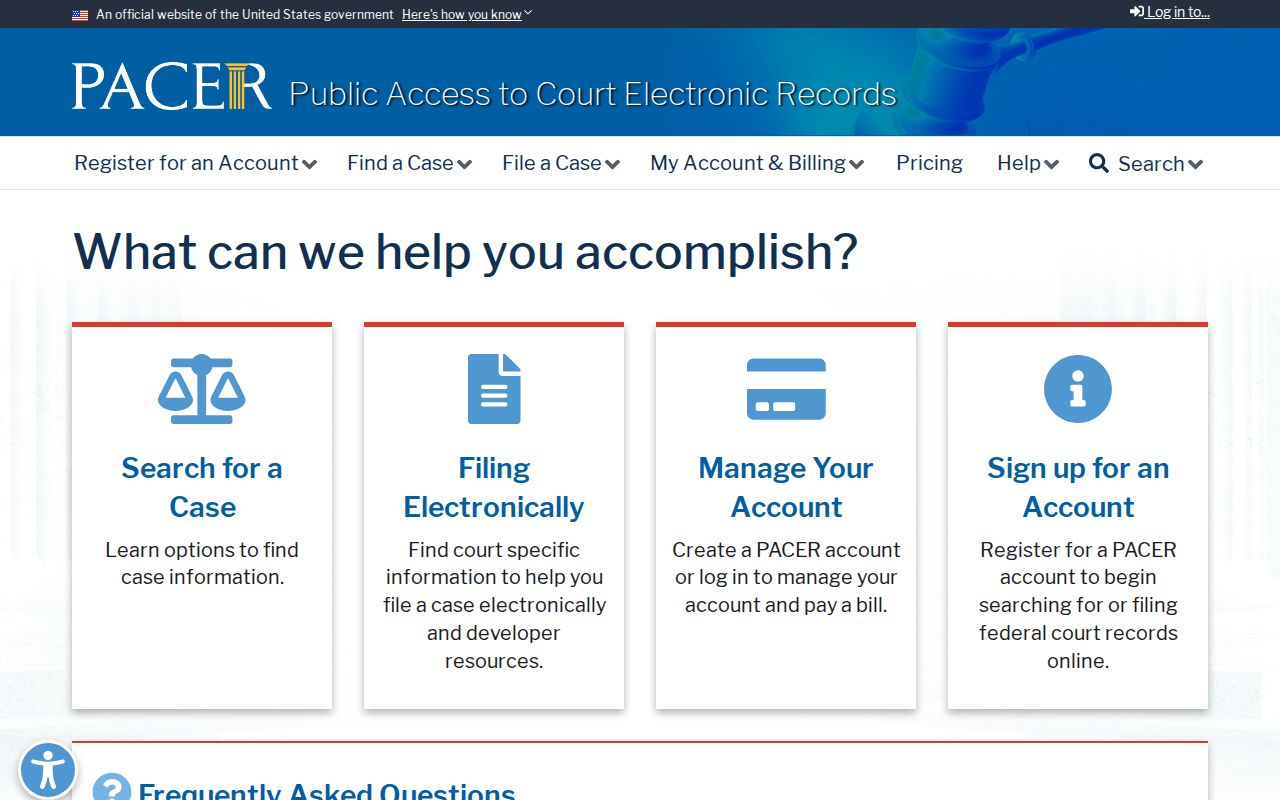
The PACER image shows a distinct federal route for a name or case search. Compare the federal party role and docket dates with local records, and avoid treating a similar name as the same Apple Valley person without two anchors.
Apple Valley Resident Lookup Limits
A one-person search is for personal, lawful research such as family history, reconnecting, civic records, an estate question, or checking a public filing. California Penal Code section 646.9 addresses stalking; section 422 addresses criminal threats; section 653m applies to repeated electronic contact in applicable circumstances; and Code of Civil Procedure section 527.6 governs civil harassment restraining orders. Public availability never authorizes surveillance, threats, impersonation, or contact that violates an order.
Lawful use. Keep a name search tied to a legitimate personal purpose, use the least identifying information needed, and stop when a custodian or confidentiality program closes the route. Never use a result to stalk, harass, intimidate, or harm anyone.
Correct a wrong result with the office that holds it: the Assessor for assessment data, the Recorder for an index or document procedure, the court for docket or record relief, the licensing board for a credential, or the vital-record custodian for an application. Record the source, date, field, and uncertainty so a later correction does not repeat the same name mistake.