
Apple Valley City Directory Shelf
Apple Valley directory research begins with a shelf check, not an assumption that a modern local publisher produced a separate run. The Arda Haenszel California Room at the Norman F. Feldheym Central Library identifies regional holdings with useful dates, while the Newton T. Bass Branch is the nearby reference starting point. The collection is strongest when a name is tested against several source types. A San Bernardino volume may include Apple Valley, Victor Valley, or only the older central-city market area, so the title page and coverage notes matter as much as the spine label.
| Collection | Years | Where Held | Access |
|---|---|---|---|
| San Bernardino city directories | 1887-1968 | Arda Haenszel California Room | In-library; check Apple Valley coverage volume by volume |
| Criss-cross directories | 1976-present | California Room | In person; address and telephone keyed |
| Telephone books | 1918-present | California Room | In person; listed subscribers only |
| The Sun and Sunday newspapers | 1894-present | California Room microfilm and library databases | In-library research; obituary and notice trail |
| San Bernardino County Great Register | 1880-1886 | California Room | In-library; period voter, residence, and occupation fields |
| Federal census schedules | 1850-1920 onsite; public releases through 1950 | California Room, NARA, and genealogy databases | In person or database access; enumeration geography changes |
| San Bernardino Valley Genealogical Society Quarterlies | 1962-present | California Room | In-library; transcriptions, queries, and family histories |
| Apple Valley and area yearbooks | Exact local run not published | Newton T. Bass catalog, school libraries | Ask reference staff to check holdings |
The table shows the documented regional runs, not a guarantee of uninterrupted Apple Valley coverage. Missing editions, changed boundaries, unlisted numbers, and a person's move can look alike. Record the exact edition, publisher, city list, and section used so a later researcher can reproduce the result.
Apple Valley City Directory Help
The Newton T. Bass Apple Valley Branch of the San Bernardino County Library is at 14901 Dale Evans Parkway. Its listed telephone number is (760) 995-8750, and the reference email is apvref@lib.sbcounty.gov. Current posted hours are Monday through Wednesday, 11 a.m. to 7 p.m.; Thursday and Friday, 10 a.m. to 6 p.m.; Saturday, 9 a.m. to 5 p.m.; and Sunday, closed. Those details make the branch the practical first stop for a person researching a regional directory from nearby.
The branch provides public computers, the county catalog, subscription databases, and a substantial historical document and photo collection. Its public listing does not publish an exact Apple Valley directory run. Ask reference staff to search for Victor Valley, Apple Valley, Victorville, telephone, Polk, Haines, school annual, local newspaper, and obituary headings. Ask whether a requested volume is on open shelf, in storage, on microfilm, or available through a database. The branch can also point a family-history researcher toward the California Room when the regional shelf is the better fit.
The Newton T. Bass branch listing confirms the local library location and its public reference route for an Apple Valley directory question.
The branch image belongs with the local shelf discussion: staff can check catalog records and direct a historical search to the California Room when a regional volume is more useful.
Note: Branch staff can confirm a volume's local coverage; a catalog hit alone does not prove that Apple Valley names appear in every edition.
Apple Valley California Room Directories
The California Room holds the most clearly documented Apple Valley directory path in the region. Its San Bernardino city directories run from 1887 through 1968. Its criss-cross directories run from 1976 to the present, and its telephone books run from 1918 to the present. These are regional records. Coverage can change by edition, especially as desert development spread beyond the older city center. The California Room also identifies The Sun and Sunday microfilm from 1894 forward, the Great Register from 1880 to 1886, incomplete county vital materials through 1910, federal census material, obituaries, quarterlies, and high-school annuals.
The California Room holdings page is the best public starting point for confirming the collection names before a visit.
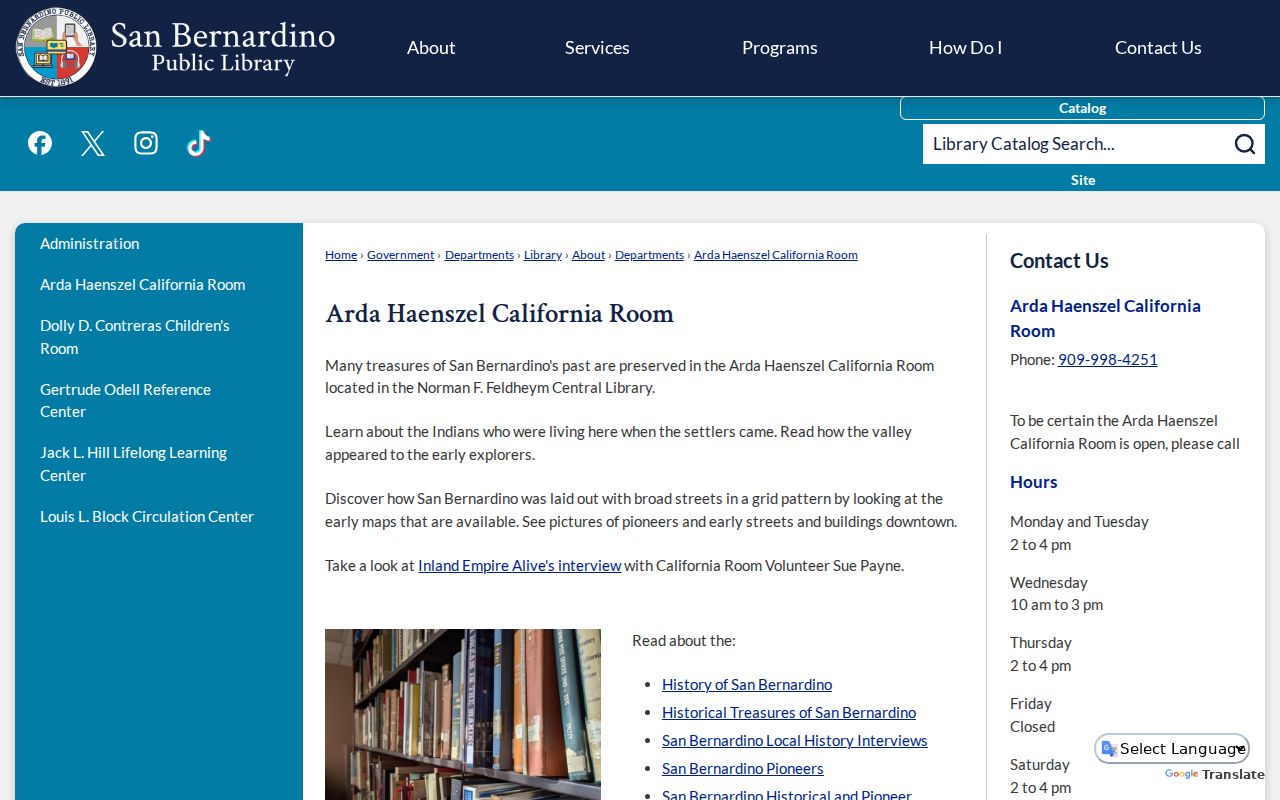
The holdings screen makes the regional nature of the shelf visible. Bring a name, an approximate year, a former street, and any Victor Valley alias; the combination helps staff decide which run and section to pull first.
Access is primarily in-library. Microfilm readers and local-history reference help matter because the searcher may need an entire street section, an obituary notice, or a neighboring entry rather than a single indexed hit. The California Room's collection description also warns indirectly against overclaiming: incomplete vital material and an exact yearbook gap are research limits, not evidence that a household did not exist.
Apple Valley City Directories at State Library
The California State Library's genealogy and California History resources add statewide catalog context to an Apple Valley directory search. A statewide catalog can reveal a county history, a newspaper, a directory title, or a finding aid that does not appear under a branch catalog search. It can also show whether a resource is digitized, held in a reading room, or available only through reference staff. Search the catalog with Apple Valley, Victor Valley, San Bernardino, ranch names, and the person or family name rather than relying on one town label.
The California State Library genealogy resource page is a useful lead for county histories, genealogy methods, and California-specific reference collections.
The statewide resource page is a catalog doorway, not an authenticated Apple Valley sample entry. Use it to find the next custodian, then verify the edition, place coverage, and access rule with that custodian.
Other responsible leads include the San Bernardino Historical and Pioneer Society, the San Bernardino County Museum, Victor Valley College library and special collections, and FamilySearch catalog entries for county deeds, probate, marriages, and registers. Exact Apple Valley-relevant FamilySearch titles and image restrictions still require a live catalog check. Private church, fraternal, American Legion, VFW, chamber, and funeral-home records may add names, but current membership rosters need permission and should not be treated as public directories.
Apple Valley Polk Directory Scans
Internet Archive has a search for scanned R.L. Polk California directories. It can save a trip when a matching volume is digitized, but the search result is not proof that a scan contains Apple Valley. Open the item, inspect the title page, read the geographic coverage statement, and look for Apple Valley, Victorville, Victor Valley, or a named ranch and subdivision in the contents or street section. The digitized collection is a discovery aid, not a substitute for the California Room's regional shelf.
The Internet Archive R.L. Polk directory search is the relevant public entry point.
The archive search shows how a digital directory lead can be tested before it is cited. Save the item title and page number, and compare the scan with a local catalog description when the place name is not clear.
No authenticated scanned Apple Valley-specific sample entry was exposed by the official collection pages during research. That gap should remain explicit. A typical Polk-style entry can be inventoried only after viewing the actual edition, because abbreviations, symbols, telephone fields, and street sections vary. Do not turn a generic scan into a claim about a particular Apple Valley household.
Reading Apple Valley City Directories
A printed directory entry is a compact clue set. The name may be a head of household, a spouse, a widow or widower, or a person listed by initials. The address may be a home, a rooming place, a business, or a subscriber location. Occupation and business information can help distinguish two people with the same name, but it is historical context, not proof of residence. Read the edition's abbreviation key before interpreting any mark.
| Name | Surname, given name or initial, and possible spouse or widow notation. |
|---|---|
| Household clue | Family notation, boarder or rooming language, when the edition defines it. |
| Occupation | Trade, title, or business line as printed in that year. |
| Address | House number, street, business address, or other location field. |
| Telephone | Listed subscriber number when the volume includes one; omissions are common. |
| Symbols and abbreviations | Owner, occupancy, home, rooming, and other marks only after the volume key confirms them. |
- Criss-cross directory
- A later address-order or reverse section that starts with a street and number, then names a listed occupant or subscriber.
- Householder index
- A name-order index that may point to the head of a household rather than every person who lived there.
- Abbreviation key
- The edition's legend for shortened occupations, relationship terms, street forms, and symbols. Photograph or transcribe it first.
- Listed subscriber
- The person or account tied to a published telephone listing, which may not equal every household member.
The mandatory sample-entry check is still open for Apple Valley. Until a librarian confirms a local volume, use cautious language such as “the entry lists” or “the directory places a subscriber,” not “the record proves every resident.”
Trace Apple Valley City Directory Households by Year
Household tracing works best when one directory year is treated as a dated snapshot. Start with the newest edition that plausibly covers the name or address, then move backward and forward while recording spelling, street form, spouse, occupation, and listing status. Pair the directory with the census and newspaper record rather than asking one volume to answer every question.
- Find the person in a name section or locate the address in a criss-cross section. Copy the entry exactly, including initials and symbols.
- Check the prior and next directory years. A changed address, spouse notation, or occupation can separate two same-name people.
- Search Victor Valley, Victorville, High Desert, ranch, tract, and former community headings when Apple Valley is absent.
- Pair 1850-1920 research with the onsite census set, then use public federal releases through 1950 for later household snapshots.
- Close a likely trail with The Sun, an obituary, probate, a cemetery lead, or an official vital-record request.
The 1950 census is the latest public population census in 2026 under the 72-year release rule; the 1960 census is scheduled for release in 2032. Earlier Apple Valley households may appear under township or enumeration-district geography because the Town incorporated on November 14, 1988. A missing directory entry can mean a move, death, unlisted telephone, changed coverage, or a changed heading. It does not by itself establish a vacant address.
The Sun and Apple Valley Directories
The Sun and Sunday newspaper run, documented from 1894 to the present in the California Room, can supply the event that a directory omits. Obituaries connect a name to relatives and former communities. Legal notices can show an estate, a name change, or a public filing. Marriage items, club news, school coverage, and property advertising can anchor a household to a place and date. Search under Apple Valley, Victor Valley, Victorville, and older road or ranch names.
Newspaper text is secondary evidence. OCR can miss initials, hyphens, diacritics, and desert place names. Read the image on microfilm or in the library database when a search result matters. Compare a notice with a directory, a probate case, or an official certificate. The newspaper can bridge a missing directory year, but it cannot turn an unverified name into a complete resident list.
Note: An obituary may identify kin and a former address, while an official certificate remains the source for certified vital facts.
Apple Valley City Directory Aliases
Apple Valley existed as a community and postal name for decades before incorporation. A historical volume may therefore sort a family under Apple Valley, Victor Valley, Victorville, High Desert, a ranch name, a subdivision, or a tract rather than the current Town label. Search those aliases before concluding that a person or street is missing. A postal Apple Valley address can also describe territory outside the incorporated Town, so the municipal boundary must be checked separately.
Before November 14, 1988, permits, planning, roads, and local-government files generally originated with San Bernardino County or another county custodian. After incorporation, the Town of Apple Valley became the keeper for its own municipal series. That custody shift explains why a directory clue may need a county search for one decade and a Town request for another.
Apple Valley Ranchos and the development work associated with Newton T. Bass and Bernard “Bud” Westlund shaped later subdivisions, street growth, and local advertising. Roy Rogers and Dale Evans are part of the civic geography, and their names can lead to newspapers, tract materials, photographs, and public history records. Search road names and project names alongside a directory surname. Keep an alias log with the exact wording used in each source.
Apple Valley City Directory History: Aerials
No verified Apple Valley Sanborn sheet-year run was located in the Library of Congress catalog during research. Sanborn maps are therefore not a safe assumed source for every local parcel. For a low-density desert town, historic aerials, USGS topographic sources, tract maps, assessor maps, permits, and Town environmental appendices may show development more clearly than a fire-insurance map. The Library of Congress Sanborn collection is still worth checking for a specific place, but a coverage gap should be reported.
Town cultural-resource studies demonstrate a useful local substitute. Their historical review used dated aerial and USGS checkpoints that can help explain when a directory address changed from open land to a subdivision or commercial frontage.
- 1953 and 1969: early landscape and ranch or tract context.
- 1973 and 1984: growth before and around the incorporation era.
- 1994 and 2005: later subdivision and road-development comparison.
- 2009, 2012, and 2016: recent site-change checkpoints in the cited local study.
Apple Valley City Directory Research Partners
The strongest research path may require more than a directory shelf. Responsible local partners can supply context, referrals, or a second record type. Ask what is open, what is restricted, and whether a volunteer index points to an original source.
- San Bernardino Historical and Pioneer Society and the County Museum for pioneer files, photographs, oral history, and regional context.
- Victor Valley College library or special collections for former students, faculty, and yearbooks under its public-access rules.
- American Legion, VFW, churches, fraternal groups, and chambers for voluntarily published historical rosters, with permission for current lists.
- Funeral-home obituary archives and The Daily Press or The Sun archives for family links and former residences.
- FamilySearch catalog entries for county deeds, probate, naturalization, marriages, and registers, with live verification of film and image limits.
These partners add leads, not a replacement for an official custodian. A private membership list can show participation in an organization without proving an Apple Valley address, and a secondary obituary can contain a spelling or date error.
Apple Valley City Directory Limits
The documented collection is rich, but it is not a complete Apple Valley residents directory. The regional city-directory run ends in 1968, the criss-cross series begins in 1976, and the telephone series has edition-specific geographic coverage. That interval can hide a move or a change in publication. The exact Apple Valley yearbook run is not published. No authenticated Apple Valley sample entry was exposed online. No official Town cemetery or interment lookup was located. Those gaps should remain visible in any careful family or house-history conclusion.
Use a directory as one dated layer. Confirm a name and address with a deed index, assessor parcel record, census schedule, newspaper, probate file, vital application, permit, or another source whose custodian and date are clear. For a modern one-person identity question, the Apple Valley resident lookup route adds court, vital, business, and lawful-use checks. The historical shelf remains most useful when its limits are stated alongside its clues.
Note: A directory disappearance is a prompt to test alternate years and aliases, not a finding that the household left no record.